Tunisian music
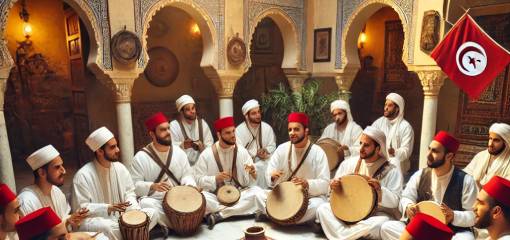
Tunisian music is an integral part of Arab music and, more broadly, of the music of Islamic civilisation. The names of its modes come from Arabic, Turkish, Persian and other languages. Its traditional songs also contain words that are sung when the musical phrase is wider than the line of poetry, in Arabic or in the languages of peoples who embraced Islam: the mode “Isbahan” (the name of a Persian city), “sikah”, from the Persian “seh gah”, the third note, and “maya”, meaning “leaven”, as well as the sung words “dost” (my beloved), “jan” (my soul) and “aman”, a plea for mercy. Players and singers still use all of these words today.
Arab music branched into four great schools: the school of the sawt, or of the Arabian Peninsula, with close ties to Indian and African music; the Abbasid school of Baghdad, or school of the maqam, reaching into Persia and the republics of Central Asia; the school of the Near East, joining Egypt, the Levant and Palestine, with strong ties to Turkish music; and finally the school of Andalusia and the Maghreb, with ties to European, African and Berber music.
Source: salahelmahdi.com
Comments
No comments yet.
Comments are closed.